Mar 27, 2011

Sizing Up Santiago


Other than cruising through Santiago by bus en route to Panama City,  I've had little exposure to Panama's third largest city.   This weekend I stayed in the home of some lovely Panamanian women, and we visited several areas of the city, as well as a few surrounding towns.  The weather was hot with a capital "H".  It was a nice change from the cold, damp and windy climate Boquete was experiencing.  And there is so much more to the city than what is seen passing though on the Interamerican Highway.  I'm seriously considering relocation there.

Santiago offers several of the big stores found in David and Panama City; ie Do It Center, Super 99, El Machetazo, Casa Gala, several educational facilities,  and a few universities.  There are also private medical clinics and a public hospital.  What I didn't see was a blatant expat community.  In fact, while attending an international festival in the town center on Saturday evening, I specifically looked for a stereotypical European, Canadian, or United States transplant. I didn't see any.  I'm certain they are there, but they weren't easy to spot and that made me very happy.   I ran into many Panamanians who were very competent English speakers.  I wasn't looking for English-speaking Panamanians, but I quickly realized that I needed to be judicious when speaking English, because the odds were pretty good that the average man on the street would understand my comments.  Education in Santiago seems to be a priority.  Schools and centers of learning were prominent, and the buildings and grounds of the institutions were well-maintained.  They seemed to be a source of pride.   I'm thinking that if I can get past the heat, Santiago might be a serious relocation possibility.  I did find a small town I absolutely loved, and spent a good deal of time exploring real estate opportunities there, but acknowledged that I need to be in an urban area to assure exceptional internet and phone availability.  The outlying areas still aren't adequately serviced in this respect.  Without internet and phone/fax lines,  I can't work, so I'll probably need to sacrifice scenery for services.  Property values seemed  a little more reasonable,  but I found no great bargains in my search of Veraguas, either. 


San Francisco de la Montaña

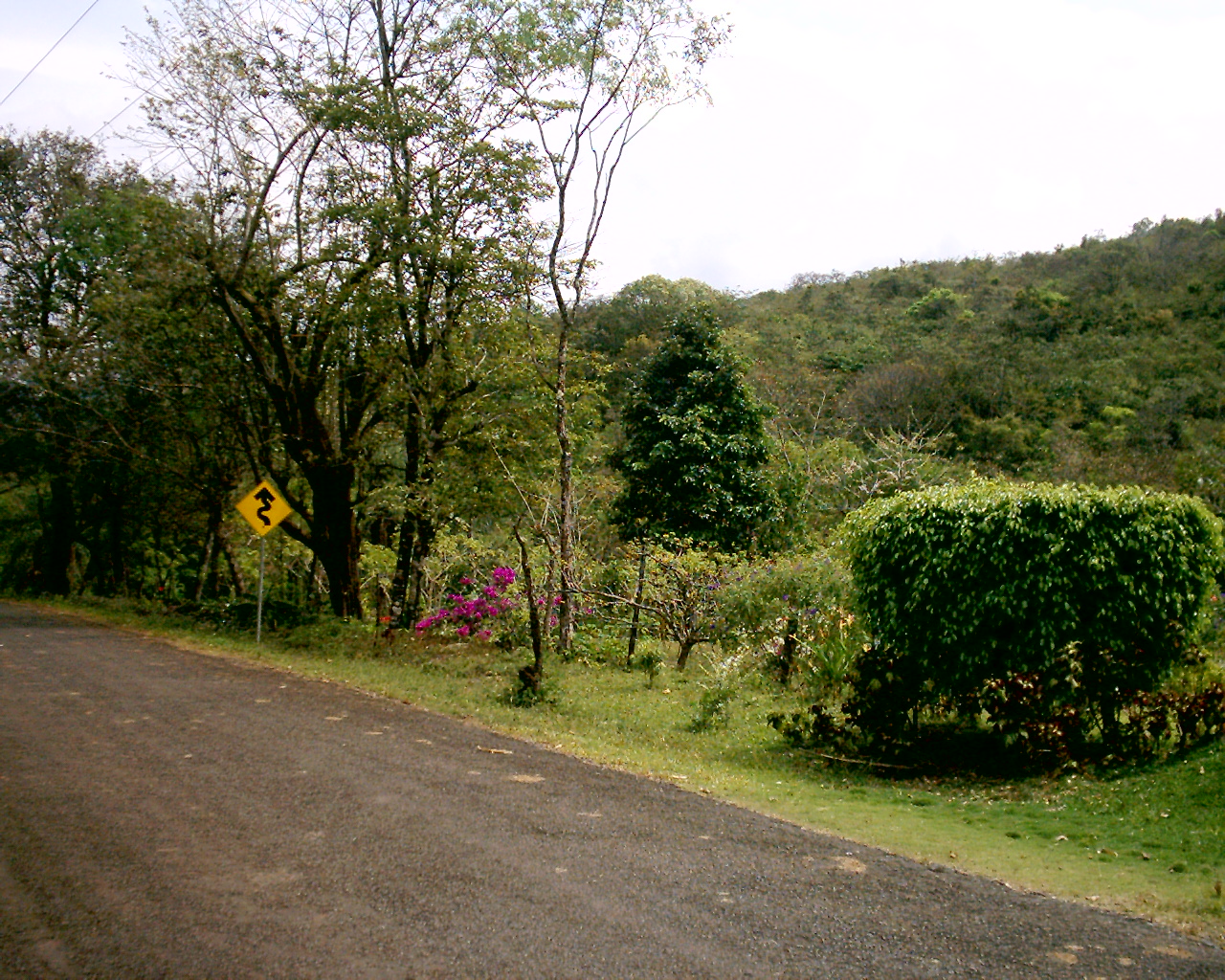
The small pueblo of San Francisco de la Montaña had been suggested to me as a possible place to settle.   I've been looking for a small, undiscovered Panamanian town where I might be able to seamlessly slip into the community without drawing attention as a foreigner,  and without signalling others to follow.  This town has a lot of history and tradition.   Unfortunately, it didn't have the right feel for me,  but I thoroughly enjoyed our brief visit.   

These photos were taken in front of the 17th century church that is the town's main attraction.  The woodwork and altar inside were beautiful to behold, but unfortunately photos with flash aren't permitted and without flash, I couldn't capture any indoor images.   The church currently is undergoing restoration but remains fully functional as the community's center of worship. 


Guess who came to dinner?

After a weekend in Veraguas I arrived back in Boquete with lots of housekeeping left to do.   My venturing out on the back deck to get laundry started, though, lead a concerned neighbor to call out a cautionary "Watch out!"  He pointed to one of the poles supporting my deck roof.    This is what greeted my curious gaze: 


Apparently while I was away, a colony of black wasps came to play.  Called the fire department, because that's who takes care of these infestations in Boquete.  They came and managed to chase off [assasinate] most of the unwanted guests, but this evening all the stragglers returned and I now have a smaller colony nested for the night.  Called once more, but no one came.  Will need to try again tomorrow, I suppose.  

Mar 21, 2011

Summer in Boquete feels like Fall in San Francisco

It's been downright chilly in Boquete these past two weeks!  The wind has been howling and brutal as well.   I'm sitting at the computer wearing flannel PJ bottoms, fuzzy slippers, and  a fleece jacket [that Barbara brought me from Milwaukee] sipping hot herbal tea.   Reminds me of the way it feels in the SF Bay Area just before Halloween hits.   Where did I go wrong?  Is this really the tropics?

Mar 12, 2011

Las Olas

Perhaps my timing is off in posting these art reference photos I took at Las Olas beach.  But in deference to the tragedy of the recent earthquake and Tsunami in Japan, these are photos of a calm seascape in Chiriqui.  I post them for my sister, Barbara, who has returned to the snow and cold of the great lakes region.  May they burn in her memory and keep her focussed on returning next February!


Another Thing I Love About Boquete


At 7 pm on a Saturday evening, I developed symptoms of an acute and uncomfortable infection.  Having previously tried getting antibiotics without a prescription from local pharmacies, I knew better than to even try this time.   I was aware the condition would get progressively worse in the next few hours, having been through it all before.

I called Dr. Chen, a general practitioner who has seen me before.  Apologetically, I explained my circumstances and asked what he suggested I do.  Unhesitatingly, he told me to come to his office.  He was waiting for me when I arrived 10 minutes later, examined me, prescribed an antibiotic, provided updated medical teaching re: the condition and treatment, then sent me on my way.  He told me to never worry about calling if I needed something.  He said he kept the office open until 9 pm every night, and if I had an urgent need past that time, to just ring the door bell outside the office or call him.  I now have his cell phone number as well. The consult was $ 10.  The pharmacy charged me $ 13.00 for the antibiotic, after providing a senior discount I never asked for.

Situation SOLVED in less than 30 minutes, for under the cost of a co-pay at Kaiser in the states.

Mar 6, 2011

Boquete Jazz Festival

Well, the Boquete Jazz Festival has come and gone and seems to have been a success.  I was mildly offended by the donation scalpers in central park on Sunday, though.  Local announcements stated there was a free concert in the park from 11 am to 3 pm as a gift to the community.  But in actuality,  concert-goers were accosted from all angles and donations aggressively requested. 

I arrived during a lull in the performances.  Immediately upon setting foot in the park, --like mosquitos attracted to a warm body at twilight,--- the hawkers alighted and shoved plastic pitchers in my face.   I mentioned it would be nice to hear some music first, and one of the collectors snapped, "Well, it's been going on all morning!  I remarked I just arrived and hadn't heard any jazz yet. 

The Sunday performance was a wrap up  to several appearances musicians made at local restaurants. (Places are too costly for a lot of locals to attend.)  It was a "gift to the community",  but what any curious Panamanian or Ngobe attendee observed were  gray-haired hipsters in jeweled chains & bracelets, with silver-studded hats, carrying plastic pitchers and asking for money. 


The atmosphere was quiet and restrained the short while I remained.  Not sure if it was because the music was unfamiliar, the location was sub-optimum, or if it was because of the people hawking donations.   Whatever it was, it wasn't anything to rave about. 


The after party at Las Ruinas, on the other hand, was fantastic.   The place was swinging, the music superb, and the crowd delightful.  Donations were requested there, as well, but it was done tactfully, at the end of magnificent performances by very accomplished musicians, and I couldn't wait to drop my money into the pitcher.   My feeling is that they "Let the free [Central Park] concert  be free," and only collect in the other locales.   But that's just me...

Snapped a few photos during the Las Ruinas after-party and jam, but they aren't very clear.  As I said, the event was a lot of fun....


Feb 20, 2011

Another tour of the Panama Canal

The first time I saw the Panama Canal, it was on a half-day transit trip on a tourism ferry.  I enjoyed the tour that time.   But because Barbara's arrival date and visit duration precluded taking the same tour again, we improvised and saw the canal from two different viewpoints .  On Day 1 we explored the canal up-close on a small launch that included an eco-tour of Lake Gatun and some of the small islands therein.  We kayaked to a waterfall,  lunched on a river barge, visited monkeys, and petted iquanas, crocodiles and boa constrictors. 


On Day 2, we visited the Miraflores Locks,  watched large ships enter and transit through them, and toured the 4-floor Canal Museum.  For me, seeing the operation from above and afar was much more informative than being on one of the boats transiting through the locks.   This time I could see the forest, so to speak.  The last time I was too close for an overview.


Although I'm still unclear regarding much of the physics and technology of the canal, I did understand that when passing from the Pacific to the Atlantic (Carribean), the ships are elevated a height of 28 meters, in two stages, and then lowered back to sea level on the other side.   Water utilized to raise the vehicles, currently is lost into the seas. 

The canal expansion project, which includes construction of new, larger locks, will have a system to recycle the water utilized for this process.

An Embera Indian Village

My sister, Barbara, and I took a day tour from Panama City to visit an Embera village established approximately 60 years ago along the mouth of the Chagres River not far from the canal.  It's a small community that continues to struggle against the effects of progress and modern civilization.  Solar panels seen in the above photo, however, are examples of one beneficial influence brought in from the outside world.   

The village has been adversely impacted by regulations against farming, hunting, and fishing that went into effect when the area was converted into a national park.   The government provides some educational and economic assistance, though,  to help  the community convert from their traditional lifestyle into a current adaptation brought about by forced tourism and the sale of artesan products. 


Our guide relayed that the transition has not been an easy one.  The community was reportedly better off living in their traditional manner.  Present day sales from baskets, beading, and carved items drops during the low season, and even the income earned during high season  is insufficient to support the community's needs.  Product pricing is marketed as reflecting one dollar for each day's toil.  In other words, an article priced at $20 supposedly reflects twenty days of Indian labor to produce. 

Prices charged in the village were significantly lower than similar items seen later in Panama City markets and souvenier shops.  I regretted not having purchased more items during the trip. The villagers admited, however, that many of the  materials used in their modern day crafts are purchased in Panama City,  as opposed to being obtained and prepared from plants and vegetation in the surrounding environment.  A matter of convenience as much as environmental preservation, I suppose...


The village spokesman told us they continue to employ their own health care practices, utilizing botanicals and traditional medicine.  But they also have access to public health care in Panama City, and do utilize these resources at times.

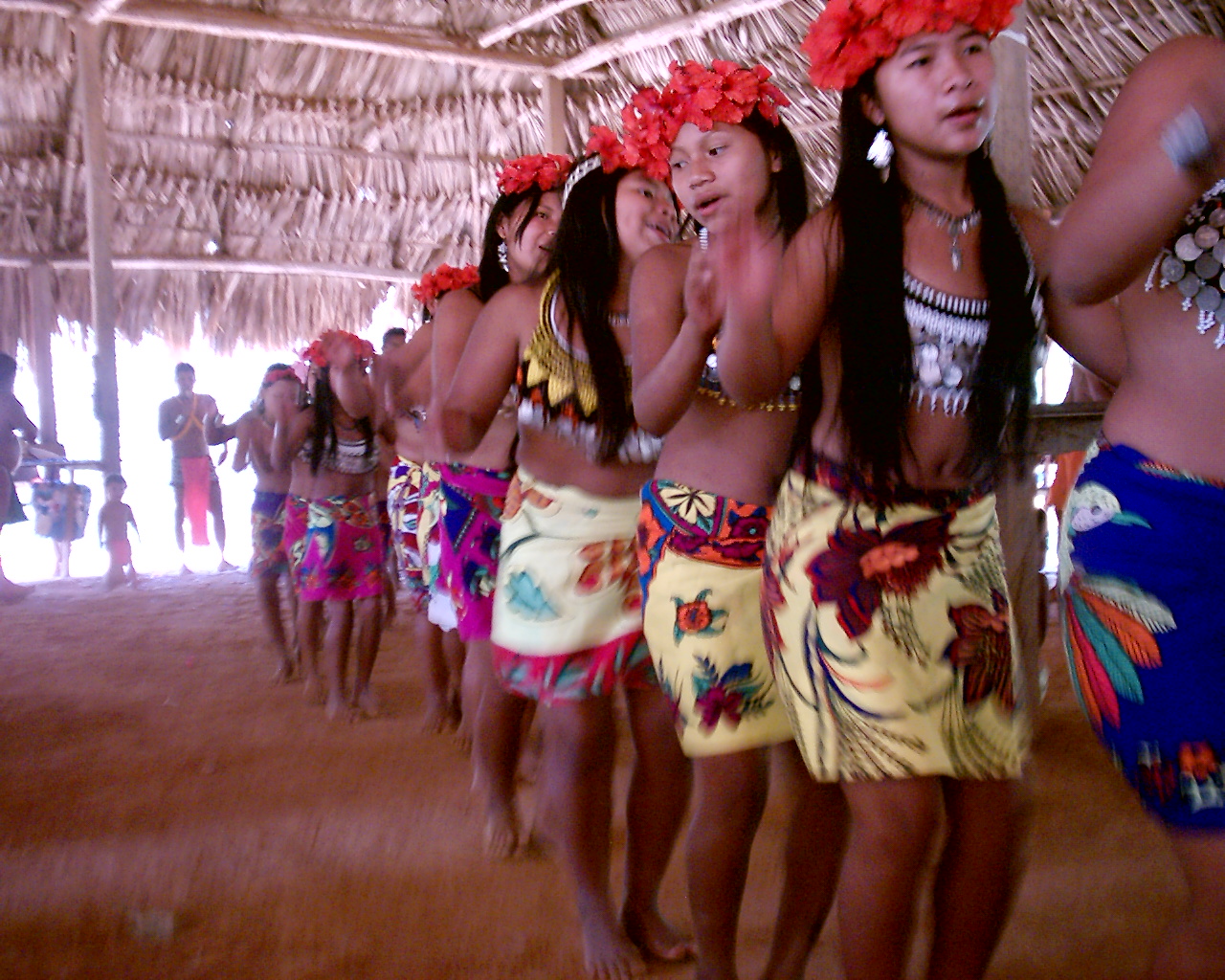
Traditional dance is supported by male musicians who play flutes, tortoise-shell drums, and sing and chant.   The women of the village dance in lines that circle, with movements representing animals, such as hummingbirds and monkeys.  


Transportation is by dugout canoes utilizing power motors, and then by public buses where roads exist.


It was more than an hour's drive from Panama City to the boat launch rendevous point, and then another 30 minute boat ride from point of embarkation to the actual village.  The villagers were hardworking and friendly, and fed us a very tasty lunch of fried tilapia wrapped in banana leaves, accompanied by patacones and fruit.  We were also taken to a remote spot where we treked a short distance to a refreshing waterfall with a deep natural pool at it's base.  There we were able to swim and cool off from the hot mid-day sun.  It was a thoroughly enjoyable and unique way to spend the day.

Jan 30, 2011

Prices in Panama are really UP !

I wish I understood economics and financial trends, and I wish I had even a trace of business savvy.  But unfortunately I am worse than worst in these areas and fear I'm just too old to learn at this stage of my life.   That said, I'd give anything to understand why prices skyrocket as they do in Panama.  It's accepted that prices will increase over time, even in the states.  But it seems to me, they do so alot less drastically. Wish there were a clear explanation. 

Today, at the supermarket I reached for my favorite cheese, which routinely has cost $5.69 for a standard, round, waxed mold.  My jaw dropped when, practically overnight, the price tag read $ 7.49.  The price for my favorite wine had also risen  $.50.  And my favorite cut of beef, up $0.65 per pound from prices a few weeks ago.  Checked the same items at different stores, in David as well as Boquete, but the prices were consistent.

Wondering if it has to do with tourist season, or if there's some other rationale.  I remember learning somewhere perhaps 40 yrs ago that when demand increases, inflation goes up and prices rise.  Can't believe demand on these items went up that much that fast.  All I know is it isn't getting any easier to live here than in the states, and that's an important consideration.   The cheese I like so much---made next door in Costa Rica---is cheaper at the local Mexican supermarket in the states than it is right here, or even in Costa Rica, for that matter.   Can someone explain this to me?

Jan 22, 2011

Could You Please Tell Me Where I Am?


Did I mention  I love having my own Panama vehicle?  There's so much to see, but until recently, no way to get there.   Today,  I drove out to Caldera.  The plan was to investigate how different the weather was from Boquete.  But Caldera (the town) is a lot smaller than  imagined.  Nice, but barely there.  Two sneezes and you'll miss it.  The surrounding areas are captivating, however.   

One thing lead to another and I found myself driving for nearly 4 hours over hill and dale and dusty trail.  Got thoroughly lost.  But stopped frequently and enjoyed the sights along the way.   Here are some of them.


Eventually ended up on the road to Bocas del Toro and stopped in a small town somewhere past what may have been Gualaca.  There I was able to get directions back to Boquete.  It was a wonderful excursion, the car held up, and I met some very nice Panamanians.