May 2, 2012

My [Panama] Neighborhood Revisited


I posted photos of my Panamanian neighborhood on a previous blog, and really wanted to transfer that post over. But I didn't save the photos, and trying to add a copy of the photos from a copy of the post isn't working for some odd reason. One of these days I'll do another walk about and update my prior post with new photos. Some of the houses I photographed six months ago have undergone new ownership and significant changes in appearance, anyway.

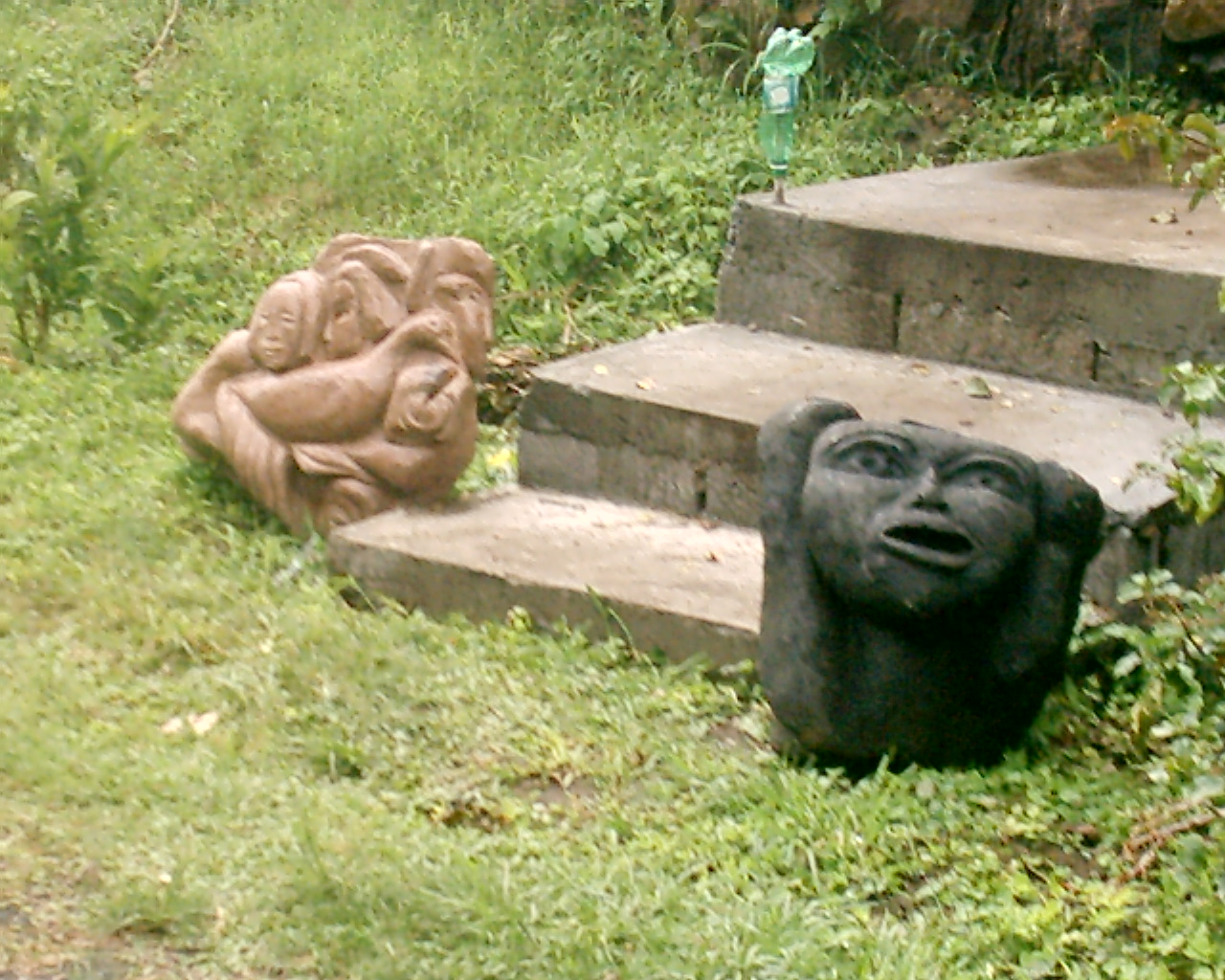
I did want to mention a neighbor just 2-3 doors down, however. He's in the house next to the guitar player, and is busy sculpting away at some stones recently dumped on the roadside near the edge of his yard. Here are some of the projects he's working on...


The house itself is a virtual shack, but it's made so much more picturesque by the art pieces just sitting around for passers by to enjoy. It's been a lot of fun watching these figures evolve out of the raw stones originally placed there. I've spoken to him a few times about selling the pieces. He may eventually do so, but isn't so motivated at the present time. Their market value is out of my price range, in any event. Probably still a bargain by stateside prices... Ah well, for now, I can enjoy them for free as they just sit out there unfenced, unguarded, unprotected and unassuming.

Apr 17, 2012

Mike's Global Grill

I previously didn't frequent this restaurant based on reviews in Boquete NING regarding bad service and poor food.  Recently, though, I've been there twice with friends, once during the weekend and once mid-week.   I was very pleasantly surprised.  The restaurant has a warm, friendly atmosphere, the owners were attentive and very cordial, and the food was excellent.   Wait staff was also superb and the time from placement of food order to table beat Las Ruinas and Amigos by about 200%.

I'm not sure about the beef some people have with this restaurant, but based on personal experience I'd say it's unfounded.   I plan to frequent the place more and would encourage anyone who has been holding back for reasons similar to mine, to ignore the malicious reviews and see for yourself. 

Meet you there!

Apr 14, 2012

Good Morning Boquete!


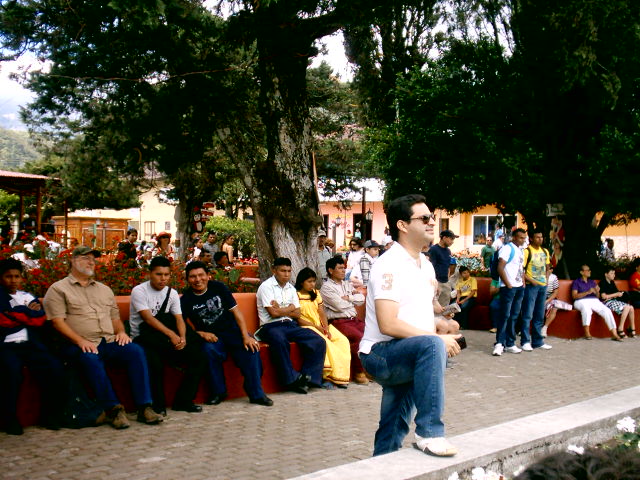
It's an eventful Saturday in Boquete today.  A few days ago the pueblo celebrated its 101 birthday with a parade.  Now there's a pet show and parade scheduled for 10:30 am (hasn't started yet---still getting organized in true Panama fashion) and varied games scheduled for the town square later.  People are hanging balloons everywhere and it's a morning of activity and anticipation.


The weather has been absolutely wonderful for the last several days.  Sunny and warm most of the day---not too hot, just right!  Then cool down in the late afternoon and nice sleeping weather at night.
I'm becoming so used to this climate that when the temp drops to around 70,  I start to "freeze".  See photo Martha snapped last night around 11 pm at Amigos.   I'm trying to down 8 glasses of water a day as part of my weight loss program.  The jacket was compliments of another considerate friend.


Martha needs to update the chronometer on her camera, obviously.

Apr 8, 2012

Cross-cultural differences at Easter


This is the first Holy Week that I've spent in Panama.    I spent most of it with Panamanian friends who explained to and  guided me regarding this country's cultural and religious observances of Easter.   I was baptised Lutheran, but even so, with the separation of church and state such a strong issue in the US, even Lutheran religious practices have been "watered down" and I've never experienced many of them.

In the Lutheran church, as well as most Protestant churches, we have services on Good Friday to commemorate Christ's crucifixion. And some of us may fast or will only eat fish on Good Friday.  But the focus of all  Protestant worship during this time is the resurrection.  Easter Sunday is the most celebrated day in terms of worship, church attendance,  praise and inner reflection.  Even the secular sector gets involved with this day, and Easter comes second only to Christmas in terms of business exploitation.  Interestingly enough, this is not the case in Panama and probably not so in other Latin American countries.  Good Friday is the day that is more widely celebrated, and there are no Easter bunnies or colored eggs on Easter Sunday.  Business pretty much resumes as normal on Easter.

In Panama, government and businesses close on maundy Thursday around noon. The sale and/or consumption of alcohol in any business establishment is prohibited by the government.  Supermarkets can't even sell cooking wine.  On Good Friday, the commercial and governmental world comes to a standstill.   In every town or city in Panama, there is an evening  religious procession.  In Boquete, the streets are cordoned off around 6 pm, and the procession generally gets started later, around 8 pm. 

Having been impressed with the procession for the Virgen de la Medalla Milagrosa in Santiago last July, I was looking forward to Boquete's Easter procession as well.   It certainly wasn't what I expected, even though in retrospect it makes perfect sense.  Don't know what I was thinking...

Compared to the Santiago procession, which is a procession of praise, the Good Friday procession is one of mourning.  It is a symbolic funeral procession.  And, for me, it was macabre.  I discussed my gut reaction with friends, but few understood my point of view.  I could only mildly comprehend theirs.  Nevertheless, it was nice to be able to talk about and share our cultural differences.

My camera was hiding on Good Friday, so I couldn't take pictures. But the procession consisted of  four floats and a lot of people on foot with somber faces.  The first float simulated a crucifixion cross, and several bent-over men carried the huge monstrosity on their shoulders   A large sign in the shape of a heart was illuminated at the head of the structure, with the words Peace and Love written in Spanish.  The second float was a glass coffin with a religious image of a dead, agonized and bleeding Christ inside.  Between each float was a crowd of people who solemnly walked along and prayed intermittently.  The third float unsettled me the most.  It was a float of Mary, mother of Christ, dressed in beautiful gowns.  I didn't hang around for the fourth float, as it started to rain and get cold. 

Don't understand why I was bothered by the procession.  All I could think about was that the Catholic Church was brainwashing and exploiting the masses.  I usually don't harbor this attitude, but  I just felt that the coffin and the queen's robes were superfluous overkill.  Too much  melodrama.  Friends and I discussed [and disagreed with] the elevation of Mary's status.  My female friend's perspective was that  Mary, as Christ's mother, is a very important personage who didn't receive the acknowledgment, respect and importance  she deserved during Christ's time.  This friend thought the acknowledgment of the impact of Christ's mother was imminently important...  I pondered whether the Catholic church in Latin countries provides this idolized recognition to satisfy matriarchal social structures.  And although I didn't express these latter thoughts  aloud, it was interesting that a male Panamanian friend nodded in understanding when I asked why Mary was being paraded around in fine garments.  He didn't comment, however. 

The Santiago procession, which was Mary worship on steroids, didn't grate on me to the same extent.  Maybe I was too wrapped up in the picturesque-ness of that parade to ponder the significance of it all.  Being a closet feminist and mother myself,  I'm very surprised that I'm bothered by the idea of Mary adoration.  Why in the world would I criticize or discount Mary's importance?  Could it be because of a covert chauvinism in my own religious upbringing?  I haven't the faintest idea.  But it bothered me to see Mary dressed in a queen's robes and paraded along that way.  I'd love to speak with a religious psychiatrist or psychologist about this.    There is a Hispanic saying that I thoroughly enjoy---Cada mente es un mundo---(every mind is a world).  Maybe I need to explore my own a little more.

The main point to be made is that Panama focuses on the crucifixion of Christ. The closure of government and businesses, and the banning of alcohol in public places is part of the expression of mourning and deference.   For the day of resurrection,  which we celebrate,   Panamanians attend an Easter mass, after which life returns to normal.  Businesses open back up, alcohol can be consumed, and families return to eating meat. 

I have no objection to Easter eggs and chocolate bunnies, believe me.  But I appreciate the Panamanian observances for being more in tune with the true meaning of Easter.   Not thrilled about the Good Friday processions, though.  Que será, será.   

Mar 30, 2012

Sick over GOP Resistance to Affordable Care Act

I've spent several hours listening to the Supreme Court arguments regarding the constitutionality of health care reform as approved under the Affordable Care Act.  It was actually nauseating at times to listen to Paul Clement pull no stops in defending the insurance industry's interests under the guise of defending 26 republican states.   How can that man look in the mirror each day?  Maybe he doesn't....

The most obnoxious moment for me was when he said,  "I think there are other options that are available. The most straightforward one would be to figure out what amount of subsidy to the insurance industry is necessary to pay for guaranteed issue and community rating. And once we calculate the amount of that subsidy, we could have a tax that's spread generally through everybody to raise the revenue to pay for that subsidy."   

 I guess he worries about those HMO executives who earn a mere 14 million a year in salary.  If their companies were forced to provide guaranteed issue policies to the uninsured, they might see a drop in their profit margins and have to live like the rest of us.  If Medicaid is expanded in all states, via the aid of the federal government to the tune of about 90%,  please tell me why it's more objectionable to the GOP than bailing out the banks? 

I am extremely concerned about the pending supreme court decision.  If the ACA is defeated I think I will lose all  sense of pride and allegiance to my country.  It will be more than just a major blow.  I am just hoping against hope that the ACA is upheld. 

In one of the professional publications I receive,  there was a synopsis of the ACA written by John E. McDonough, DPh, MPA,  Professor of Health Policy and Management, Harvard University School of Public Health, Boston, Massachusetts.   I'm going to cut and paste it below.  After reviewing it,  I challenge anyone to find a rational reason to advocate its defeat. 


Title I. Quality, Affordable Health Care for All Americans

This title fundamentally changes the nature and operation of private health insurance in the United States. Beginning in 2014, no health insurer will be able to sell or rate coverage based on an individual''s medical history; most Americans will be required to obtain health insurance; and substantial financial subsidies will be available to low- and moderate-income Americans to help them afford the cost of health insurance. Most states will operate new "health insurance exchanges" to make shopping for health insurance easier. Small businesses and individuals can shop these insurance exchanges for competitive rates. Other important changes in health insurance, including the banning of lifetime and annual benefit limits, were implemented in 2010.

Title II. The Role of Public Programs

This title creates substantial changes to Medicaid, the federal-state program for many low-income persons. Beginning in 2014, all lower-income individuals will be eligible to enroll in their state's Medicaid program, not just those who fit into categories such as disabled, children, or parents. For the first time, Medicaid will become a more uniform national program with uniform eligibility and enrollment standards as well as quality improvement requirements.

Title III. Improving the Quality and Efficiency of Health Care

This title establishes new mechanisms to improve the quality of medical care in the United States by making it more efficient and effective, and more patient-centered. Medicare will be improved with the addition of new preventive benefits for enrollees; and the Medicare Part D drug benefit will be made more affordable by closing the coverage gap known as the "donut hole." Medicare's rate of growth will be lowered to provide about $450 billion in savings between 2010 and 2019, which should fund about half the cost of the ACA.

Title IV. Prevention of Chronic Disease and the Improvement of Public Health

Title IV is the most ambitious law ever passed to promote healthier lifestyles for all Americans and to prevent disease and disability. A National Prevention, Health Promotion, and Public Health Council will devise a national prevention strategy, backed up by a $13 billion Trust Fund. Evidence-based clinical preventive services will be provided in most public and private health insurance policies without cost-sharing. Chain restaurants will be required to post the calorie content of their foods.

Title V. Healthcare Workforce

This title establishes a National Healthcare Workforce Commission to analyze and plan for workforce needs and to make recommendations to congress and the administration. Support is provided to expand the healthcare workforce, especially in primary care. Major expansions for community health centers and the National Health Service Corps are funded.

Title VI. Transparency and Program Integrity

Title VI provides new authority to federal and state agencies to combat fraud and abuse in Medicare, Medicaid, and private health insurance. Drug companies and medical suppliers will report most gifts and other gratuities to physicians for public release on a federal Website. The Patient Centered Outcomes Research Institute is established as a public-private entity to support research on comparative clinical effectiveness. New transparency requirements on the nursing home industry will provide information to protect and empower patients and their families. The Elder Justice Act provides a national framework to combat violence, neglect, and financial exploitation of senior citizens.

Title VII. Improving Access to Innovative Medical Therapies

This title directs the US Food and Drug Administration to develop a regulatory pathway to permit the development, manufacture, marketing, and sale of biosimilar biologic products, generic-like versions of biopharmaceutical drugs. It also ends anticompetitive efforts to keep generic drugs off the market, and offers drug discounts to hospitals and communities that serve low-income patients.

Title VIII. CLASS: Community Living Assistance Supports and Services

This title authorizes a new national and voluntary long-term disability insurance program to provide workers with daily cash payments and support if they become permanently and temporarily disabled. People who enroll in CLASS must pay premiums for a minimum of 5 years. The funding is flexible and can be used for a range of services. No tax money will be used to fund this program. Its only permitted financing source -- enrollee premiums -- must be sufficient for at least 75 years if the Health and Human Services Secretary is to launch the program.


Editor's Note: The Obama administration announced on October 15 that it was abandoning plans for CLASS. Congress is expected to quickly draft legislation to repeal the provisions of this title.

Title IX. Revenue Provisions

This section covers the financing for slightly less than half the cost of the ACA. Key provisions establish new Medicare taxes on high-income wage earners, as well as new taxes on pharmaceutical manufacturers, health insurance providers, and medical device manufacturers. Also included is an excise tax on high-cost, employer-provided health insurance; changes to health savings accounts and other individual health accounts; and a 10% tax on indoor tanning services.

Title X. Strengthening Quality, Affordable Healthcare for All Americans


The final title in the act is the "Manager's Amendment," which includes amendments and additions to Titles I-IX, reflecting the unusual legislative process leading to passage of the ACA. Additional changes to Titles I-X were approved in a separate measure called the Health Care and Education Reconciliation Act (HCERA) signed into law by President Obama 1 week after he signed the base law on March 23, 2010. This title also reauthorizes the Indian Health Care Improvement Act, which provides healthcare to American Indians and Alaskan natives.

Mar 29, 2012

Artist Exhibition and Auction

You are  invited to an exhibition of paintings by noted local artist,  Marjorie Freiburghaus, being held April 4th through April 7th,  at the chapel and adjacent locales in Valle Escondido,  from 1:00 pm to 5:00 pm.


Ms. Freiburghaus has exhibited in multiple galleries in Panama City where she’s frequently commissioned  for private pieces.  She’s gaining popularity in Boquete, as well,  for her colorful abstract, scenic, and folk depictions. 


This event is a benefit to raise funds for oncology treatment.  Nineteen works will be displayed and available for purchase.   On the final day of the event, there will be an auction for any remaining pieces,  between 4 pm and 6 pm.


For additional information call:  720-2454 (Valle Escondido) or you can email me at summerscharlotte@gmail.com

Mar 28, 2012

Law 11 of 3/26/12---The Indians Won


According to TVN  local news sources,  this past Monday,  3/26/12,  President Martinelli signed and sanctioned  Law 11,  which also carries the signature of the Minister of Commerce and Industry, Ricardo Quijano.   This law establishes a special regimen of protection of mineral, water, and environmental resources of the Ngobe Bugle comarca and its defined, annexed areas in accordance with Law 10 of 1997.  It further recognizes the soverignty of the indigenous over these resources.  The new law cancels and prohibits concessions for the exploration, exploitation, and extraction of mineral resources and prohibits the alteration of river mouths, channels, and tributaries.  It also prohibits private appropriation of water sources.  Any future discussion or proposals regarding the establishment of hydroelectric plants must be approved by a general, regional or local congress and later submitted to a referendum of all entities involved.   The new law also obliges any future hydroelectric projects to dedicate 30 per cent of the benefits locally,---5 percent to the indigenous community and 25 per cent to the affected people, be they indians or local campesinos [rural residents].  It also establishes regulations regarding which indigenous organizations and persons are authorized to make decisons for the community.   The law will go into effect as soon as it is inscribed in the Official Gazette. 

Apparently the law underwent two debates in the National Assembly before acquiring the Presidential signature, so it should pretty much be official unless this political party plays the same games as previously and fails to get the law inscribed.  Given all the national and international attention, however, it seems it would be very difficult to sweep under the rug.

A great victory for the indigenous, and for the environment!

Mar 26, 2012

A Good Time Not to Be "Rich"

There have been a string of violent home invasions in Chiriqui in the last two weeks---three of them occurring in the last 8 days.  Information and details of each incident have been kept very close to the cuff, but apparently the victims are being pistol-whipped and the homes robbed.  The last incident, two nights ago, reportedly involved attempted rape. 

A community meeting is being held tomorrow at the BCP Tuesday market to discuss the matter.  As one resident told me,  "Everyone and their dog will be there."  Not me.  I'll just wait for the Cliff Notes  version to trickle down and try to figure out where and/or how I should get involved.   At this point the criminals seem to be running the show.  They have been smart enough to not strike more than once in any area and are spacing the invasion sites in towns sufficiently far enough from each other to catch everyone off guard. 

To the best of my knowledge, the recent victims have been expats, and the homes have been in Volcancito, Los Nances (Caldera), Portrerillos and Las Olas (Playa Barqueta).  The Boquete expat community has been very vocal about guns for personal protection while  living in gated communities.

Uhhh, right.   What Panama needs about now--- more gun-toting seniors living in expat islands...

I don't understand why people from first world environments have to immigrate to poorer countries  to lord it over the locals, flaunt their privilege, and then loudly complain when they are victimized.  And don't get me started re: the most obnoxious man I've ever encountered anywhere  appearing at the El Rey Supermarket in David today to verbally abuse a poor,  uninvolved, unsuspecting  stock boy because he found a rotting peach amidst the produce.  I've never been so ashamed to be even remotely associated with anyone--if only by language and country of origin.

I'm sure there will be lots said in the local forums following tomorrow's meeting.  Frankly I wish all the people with the entitled personalities would take a flying fulcrum and get the hell out. 

I honestly feel for the unfortunate victims of the brutal attacks.  But, maybe if we would all just assimilate instead of alienate,  we wouldn't be having community meetings about dealing with such sequelae. 

Mar 15, 2012

Time to Update, I Guess


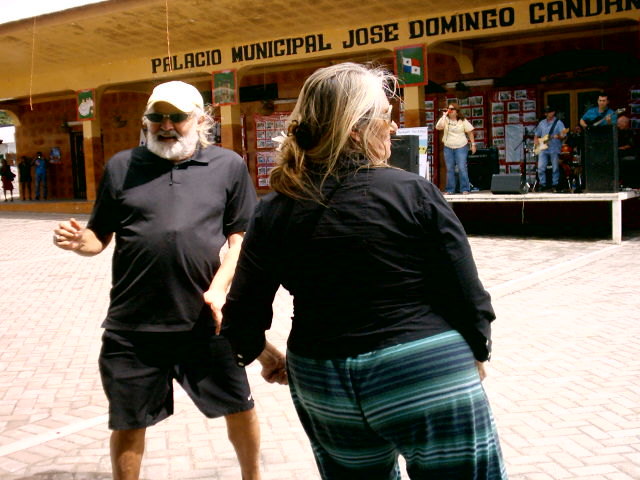
Just where does the time go? It's been about 3 weeks since my last post, and it seems like only 3 days. The Jazz Festival came and went. It was very successful despite indigeneous protest demonstrations that kept a lot of people from coming that had planned to do so.   I didn't go to the opening parade,  but did attend the jam session on Saturday night at Amigos and went to the Sunday performances.  Great music  both places.  Lots of dancing at Amigos...At one point I was holding my own with two twenty-something Panamanian lads.   Sunday evening had dinner with friends at a new Peruvian restaurant that opened where Culturas used to be.  This new place is a vast improvement over Culturas.  Hope they are able to stay in business.   The location has not had a good history.  But the food and ambiance was great, and I'd like to go again.  I think the name of the restaurant is Casona del Cuzco.   I recommend it!

Currently my time is being absorbed with house renovations and educating an Amigos de Animales rescued cat that I've named Romeo.   A sick friend has learned she needs to undergo radiation therapy, but is maintaining a positive outlook and making the most of things.  I'm trying to provide whatever support I can.   Have also taken on some volunteer work teaching English.   My days have been quite filled, and right now, boredom is appealing.  Will try to keep more current on the posts, however.    Romeo is learning not to scratch the furniture, and sends his hellos.


Feb 22, 2012

Local Sentiment re: Another Carnaval-Type Parade

Well, it seems my concerns about political incorrectness are misguided. I've spoken with a few Panamanian locals about the upcoming Jazz Festival parade during Lent, etc.  The overall response was that another parade and party-like celebration is just fine.   The best comment came from a Costa Rican man with a Chiriqui-born wife and children.  He said that religious matters were observed on Sundays, and that the only people who might take exception to the upcoming spectacle would be "a couple of priests and maybe a few old ladies."  It felt as though he were holding a mirror up in front of me!  But he had no idea what my personal views were and was just speaking off the cuff, so that's that....

I fear I'm turning into a grumpy old woman, and this is a wake up call.  Panamanians have their priorities right.  They like to party and they know how to enjoy life.   They don't take stupid stuff seriously and they try to be respectful of their fellow man-----unless their fellow man is a grumpy party-pooper.  In that case he's on his own.   Generally he's invited to join the festivities regardless.

Last Wednesday, there was a standstill in the negotiations between the Ngobe-Bugle community and the current political administration.  The Indians went back out and closed the Interamerican Highway at San Felix and one or two other spots.  Then a few people off the street were interviewed re: their reaction to the closures.  One woman said,  "I sympathize with the cause of the indigenous, as does most of the populace.  But the road closures at this time---just before Carnaval--is only hurting the populace.  The President and his cabinet all have money and can get around just fine.  It's the common man who is affected by the traffic jams.  It's the common man who won't be able to enjoy the Carnaval festivities."   Less than an hour later, the Indians opened up the road blocks and announced they would maintain a close vigil, but not interrupt traffic flow.  Negotiations would resume on 2/27/12, and if things didn't take a more positive turn at that time, they would react again with road closures. 

As I said, it's important to get your priorities straight.  I won't be at the pending parade, because I'm just not into acting silly that way.  But I've stopped worrying about being considered an ugly American.

Feb 12, 2012

Peaceful Protests in Boquete

Talks continue regarding mining and hydroelectric issues.  Yesterday's announcements regarding progress to date explained talks would be focusing on areas adjacent to the comarca borders,  which are home to many indigenous people, but considered unincorporated.  Below is a link to a short video regarding a peaceful demonstration held this afternoon in Los Naranjos, just outside downtown Boquete.


http://www.tvn-2.com/noticias/noticias_detalle.asp?id=68814

Feb 8, 2012

This should go without saying.....

but apprently needs to be said anyway.  This blog is a private and personal account of my experiences and impressions of Panama, a country I hope to immigrate to upon retirement. My posts are intended for family and friends, and occasional others who might happen upon the site and be curious about my subjective views. 

It is NOT OKAY to cut, paste, or copy  portions of my posts, change wording, and redistribute my writing in a way that gives the impression the content is either yours or your reporting of facts.   

I am no expert on Panama and don't want to represent myself as such.  I'm just someone who loves  it and is thinking of retiring in Boquete if things work out.  I express my positive and negative views, and admit they are entirely mine.  My posts are not intended to accomplish anything more than provide me a creative outlet and share a little of my time with those I care about. 

Feb 7, 2012

It's a Truce, not a Resolution

The expat community in Boquete, as well as many  Panamanians, are of the impression that an agreement was reached today that resolves the dispute between the indigenous peoples of Chiriqui and the Panamanian government.  Oh, if it were only that simple...  What did occur today was an agreement that the Indians would stop protests and begin negotiation if  the government met specific baseline conditions.  Below is my  translation of an article published by TVN-2,  Panama's national news station.

The Indians and the government reached an agreement today that puts an end to the protests begun by the Ngobe Bugle community more than a week ago.  The mediator, Montsignor Lacunza read  the Ngobe demands which are now part of that agreement.  Among these were the immediate release, without charge, of those persons detained and held in custody during the protests,  a return to their baseline status, urgent attention to those Ngobes who were injured or affected during the clashes, and permanent indemnification to the family of Jeronimo Rodriquez, who was killed during confrontations.   (My comment: Jeronimo Rodriquez is the 26 yr old man who was shot in the left chest.  In prior posts I wrote that his name was Guillermo Moctezuma and later Jeronimo Montezuma, because that's what the television stations originally reported.  Somewhere in the mayhem, his name was changed or corrected to Jeronimo Rodriquez.)  The Indians also demanded cessation of repression and persecution of the demonstrators, the Indian chiefs,  and members of the office of the National Coordinator.  This also included the dismissal of cases that were forwarded to the Public Ministry and dismissal of indigenous prisoners.   Petition was made for the re-establishment of cell phone service, immediate withdrawal of the riot squads,  and implementation of a thorough investigation by human rights organizations regarding what occurred during the demonstrations.  Additionally they want to maintain the Catholic Church as the mediator and have as observing parties the Evangelical Church, the Rector for the University of Panama, Gustavo Garcia de Paredes, and the United Nations representative.

Before signing the document, the chieftess Silvia Carrera,  expressed her gratitude to Montsignor Lacunza, who functioned as mediator in this conflict, and implored the government to keep it's promise regarding the pact. 

For his part, the Minister to the Presidency, Demtrio Papadimitriu, assured that the government will take measures to compensate the family of the deceased Jeronimo Rodriquez, and reiterated the disposition of the government for dialogue.   

Papadimitriu explained that today's agreement pertains to dialogue begun this morning   regarding the Mining Law as based on last year's agreement in San Felix relevant to the prohibition of exploration and exploitation of mineral and water resources on lands of the Indian comarca

The Minister also assured that they will proceed with the liberation of the Indians detained during the confrontations in David, Santiago, and Panama

For their part, the Indians promised to end the protests currently being organized.

Essentially what has been agreed upon is a "cease fire" while negotiations continue.  This initial agreement couldn't have come at a more opportune time.   The Boquete police had been forewarned that barring some kind of agreement today,  there would be another demonstration in Boquete center and the target would be the Boquete Police Station.  Several of the businesses in the area, including Banco Nacional,  boarded up windows and doors.  The police moved all equipment, records, desks and furniture from the police station to the Feria Building in preparation for the event.    What I found most interesting was that the required agencies and personnel were forewarned in Boquete, unlike what transpired in Volcan.    Panamanians have told me they believe the additional consideration shown to Boquete reflects an improved relationship the community has with the indigenous.  Volcan is a large agricultural area and the indigenous are farm laborers for agrobusinesses.  In Boquete the Indians are better assimilated. 

It remains to see what will happen regarding the issues at hand.  As I've previously mentioned, the Panamanian populace has been unhappy with the current administration for awhile now.   It's amazing what the indigenous have been able to accomplish with so little arms and so few numbers.   Tomorrow's scheduled Day of Protest would have been interesting  because it would have included many organizations and groups sympathetic to, but not part of, the Ngobe community's goals.  My guess is the current administration would rather this not be blatantly revealed.  It is also my guess that the result of future negotiations will be much more transparent this time around.    Hopefully they will go smoothly. 

Dialogue begins....


Much awaited talks began today at 12:30 pm in San Lorenzo at the Abel Tapeiro Miranda Professional and Technical Institiute.  President Martinelli was not there.  Present were Montsignor Jose Luis Lacunza acting as mediator,  the Minister of the Presidency--Demetrio Papadimitriu---, Minister of Government, ---Ricardo Fabrega---, and Secretary of Communications for the State, ---Luis Eduardo Camacho.  Also reportedly present were national assembly deputies  Jose Munoz (Cambio Democratico) Osman Gomez (Panamenista) and Crispiano Adames, Elias Castillo, and Crescencia Prado (PRD).

Representing the indigenous people were chieftess Silvia Carrera, and Rogelio Montezuma representing the coordinator,  among others.

At the present time there is no news regarding any resolutions or outcome.

And it goes on....


According to the mid-day news, there are continued protests in Panama City and the surrounding areas.  Attention in these areas is being given to not disrupt traffic or business activities.  Demonstrators include students from the University of Panama, whose classes remain closed, teachers from the teachers union, and varied labor organizations.  Teachers and professors in Santiago, Chitre,  Arraijan, and La Chorrera are also protesting.  Everywhere people are imploring President Martinelli to meet with the indigenous to resolve the issues at hand.  At one gathering a speaker commented that there are currently more than 10,000 indigenous people protesting, and more than 25 areas effectively closed down by the movement.  Cell phone service still has not been restored to the indigenous areas, and this is a bone of contention regarding negotiations and dialogue.  The catholic church, in particular two priests, have been recruited as mediators, and they spoke on national television to implore the President to meet with the indigenous who aren't satisfied to deal with emissaries.

The areas north are most affected currently.  Altamirante has been out of electricity for 36 hours,  and water and cooking gas supplies are dwindling.  An official from the electric company stated that 12 electrical posts have been downed and damaged, some irreversibly, and this is the reason electricity hasn't yet been restored. 

Some government officials are in David currently in preparation for the onset of dialogue.  Two others, Papadimitriu and Quijano are enroute.

Tomorrow is scheduled to be a serious day of protest, and today has already shown great public sympathy and solidarity with the indians.   The country still waits to hear the outcome of dialogue and negotiations. 

Confrontation in Volcan

A photo I can't manage to upload has been circulating in the Panamanian press.  It's  of the current President, Ricardo Martinelli, with a long pointed nose that seems to be growing.

Below is a link to a video showing highlights of today's confrontation in Volcan.  It's not pretty, and many Panamanians have denounced the destruction and disregard for property.  But these same  people acknowledge that there is even more than the mining interests involved with this crisis.   

The Panamanian populace seems disenchanted with President Martinelli. He's now viewed as an ambitious politician who has little regard for the common man. His campaign was based on exactly the opposite premise. "Ahora le toca al pueblo" (It's now the people's turn) was his slogan. Instead one of his first actions in office was to raise the sales tax from 3% up to 7%. And rumors circulate that it will increase to 8% before his term ends.   He's also perceived as a bully who pushes his own agenda despite widespread conflicting opinion . He's rumored to be heavy-handed with people who criticize him, and hypervigilant of those who work with or for him.  With the current crisis, he's also viewed as being someone who doesn't keep his promises.  I haven't met a Panamanian recently who admits voting for him or states they like him (But I'm located in Chiriqui province, which is where most of the conflict is taking place. They may feel differently in Panama City.)   Instead people here feel he presented one agenda when campaigning for election, and implemented another once in office. Many people have told me he's trying to turn the country into a dictatorship and they've even compared him to the recently returned ex-dictator Noriega. This is very far-fetched, in my opinion, but people do worry and seem very open about expressing these fears. 

The photo below, taken from a local TV channel's website, states, "Promise Kept, Mr. President" and represents a coffin for the indian man who was shot on Sunday---presumably by a police bullet, though the police are stating the bullet was not from a police issued weapon. 


The Panamanian police are now seen as an extension of the President, his policies, and his disregard for the plight of the average citizen, whose financial situation has significantly worsened since President Martinelli came to office.   Keeping that in mind, the video below takes on a different slant. It shows the indigenous people wrecking and burning the police station in Volcan.  

Although the actions of those involved in the confrontation in Volcan is condemned by most people, it has finally pushed both sides to the negotiation table.  Unfortunately, President Martinelli continues to avoid meeting with the protesters in Chiriqui, but he has sent his Minister of Government, Jorge Ricardo Fabrega, to initiate contact with the Ngobe Bugle leaders and dialogue to end the protests.  I read somewhere that the indigenous leaders expected President Martinelli to meet with them in the center of the blocked highway near San Felix, around a card table, with the indigenous community surrounding them.  Speculation is that security and safety matters  may have affected the President's decision to refuse this arrangement.  (do you think?)

It will be very interesting to see the outcome of the meeting with Mr. Fabrega, whenever it occurs.  Hopefully some type of agreement can be reached that might be more long-lasting than the one implemented last year around this same time. 

Feb 6, 2012

Border Closure

The demonstrations continue in Panama City and Chiriqui.  The Costa Rica-Panama border crossing at Paso Canoas has been closed to emmigration from Costa Rica for all but Panamanian citizens.  This is being done at the behest of the Costa Rican president as a safety measure for citizens of that country and for citizens of other foreign countries until the riots and unrest is resolved.       

The US embassy in Panama also issued an emergency warning to US Citizens as follows:

The U.S. Embassy in Panama City alerts  U.S. citizens to continued disruptions and demonstrations along the Pan-American Highway near the San Felix area in  Chiriqui (Ngobe Bugle region) and elsewhere in Panama.   There  are reports of violent confrontations between the Panamanian police and protestors in the San Juan, San Felix, Horconcitos and Vigui areas.
While the Pan-American Highway is reported to be open, protesters continue in their attempts to  block it with rocks, trees, and burning tires at various points between Chiriqui and San Felix.  Protesters have been reportedly throwing rocks at passing vehicles.  GOP Security Services continue to use tear gas and other riot control measures.  There are further reports of additional demonstrations in the areas of David and Changuinola, and of  possible demonstrations in the Panama City area beginning on Monday, February 6, 2012.  American citizens are urged to avoid areas of demonstrations, to defer traveling to and within areas known to have current protest activity, and to exercise caution in any area of confrontation between police and protestors. 
Other protests on this or other issues may occur with little or no warning.  The Embassy continues to caution its employees and all U.S. citizens to exercise heightened security awareness and avoid crowds and any areas  where there are demonstrations or where confrontations could occur.

The movement seems to be gaining momentum. The Panamanian public is sympathetic to the indigenous issues as well as against mining and hydroelectric activities in general.  The police are being viewed as repressive and the show of force has prompted more organizations to rally in support of the movement.  Educators, labor unions, syndicates and attorneys have expressed opposition to strong arm tactics and are pushing for dialogue and negotiation. 


There was a new confrontation this afternoon along the road from Boquete to Volcan.  Indians who were part of the highlands industrial and agricultural sector proceeded to take control of the area.  Police attempted to disband them, but ended up having to flee when the crowd turned on them with sticks and stones.   They burned the building housing the police station, and dismantled cars, as well as police motorcycles, to use as shields. 

Feb 5, 2012

Panama's President responds via Twitter

President Martinelli reportedly returned to Panama from the US this afternoon due to the escalation of civil unrest.   His last tweet to followers one hour ago is as  follows: 

El problema con los indigenas es que NO quieren que haya mas hidroelectricas en Panamá. Esto encarece todo y nos emprobrece aun mas
Trans:  The problem with the indians is that they don't want more hydroelectric plants in Panama.  That makes everything more expensive and creates even more poverty.

Martinelli and his family/friends are accused of having business interests in the foreign hydroelectric projects.  I don't know how to confirm or disprove this.

A copy of the original agreement signed with the indians in 2011 has surfaced.  The second point in that agreement clearly states:  The creation of a law explicitly prohibiting the exploration and exploitation of mining on Ngobe Bugle lands and the protection of water and environmental resources in the Comarca.    This is the self-same legislation that is currently being cited as the basis for protest.  The Martinelli administration apparently is forging ahead without acknowledging it, claiming instead that the indigenous groups are demanding more than was originally agreed upon.  Having seen a copy of the document,  this doesn't appear to be the case. 

The news stations are once again broadcasting.  There are demonstrations occuring in Panama City at the presidential headquarters.  Since the escalation,  39 people are reported injured,  including 7  police.  41 persons have been detained, two of them allegedly minors.  The minister of security,  who for me lacks credibility, is claiming that the bullet that killed Guillermo Montezuma does not come from standard issue police weaponry.  Mr. Montezuma was shot in the left chest. 

Lastly, the University of Panama announced it is suspending all administrative and academic activities for all branches in the country and calling a Academic Council meeting at 9 am tomorrow.  They encourage open dialogue to resolve the issues related to the indigenous rejection of mining  on their lands.

A few minutes ago I happened upon a volunteer  blog with an article by a woman who spent time last year in the indian comarca.  She has succinctly summarized the  issues fueling the current protests and the history behind the movement.  I am pasting the link below for additional reference. 

 http://intercontinentalcry.org/broken-promises-fuel-a-new-wave-of-anti-mining-protests-in-panama
 

Starting to feel like a Dictatorship

The government has shut down all TV stations due to ongoing coverage of the civil unrest in Chriqui. Internet signal is weak and intermittent.  There's supposed to be a press conference with President Martinelli going on at this very minute, but no one can watch it because of the suspension of TV transmissions by his administration.   Apparently some news is getting out to the states, but it's hard to track from here.

Radio reports indicate the Interamerican highway has again been closed by protesters.  The Organization of American States has been apprised of the unrest and is inquiring into possible human rights violations, according to newspaper articles.  It's really hard to tell how serious things are at this point.  The government seems to be running roughshod over indian protests re: governmental violation of  promises and agreements to cease strip mining on their territories.  But government spokesmen  state the indians are trying to change the original terms and are being manipulated by other groups. 

With no television coverage it's hard to sort things out.  I start to get suspicious when free press is denied.  UPDATE:  Radio Chiriqui transmissions were suspended mid-broadcast and haven't been restored.  The press conference has been moved to 5 pm, but President Martinelli is refusing to take part, deferring to his ministers instead.   Hopefully telecommunications will be restored by then.  The only information being disseminated right now is against the protest movement.

Updates

Things appear to be winding down.  25 ambulances have been dispatched to Chiriqui.  One death has been confirmed.  The deceased is Guillermo Moctezuma, and no further comments have been made regarding whether or not he is one of the indigenous chiefs.  One report indicates an autopsy will be done to determine cause of death, but other reports confirm a gunshot wound.  Two confirmed injuries---one a bullet to the gluteus and the other an injured finger due to being struck by a rock.  Another indian chieftess was located by a TV chanel  and indicated there were "many injuries and many deaths" but she was unable to confirm or provide numbers because she couldn't communicate with her people or the areas affected.

***********************************************************************************

Things started changing as I was writing this.  Veraquas has been restored, according to the governor of the province,  and Tole is clearing,  but areas further north are reacting.  Altamirante, Miraflores, Changinola, and Bocas del Toro sectors are getting involved and closing roadways.  Trees are being fallen to block the road and people are throwing rocks at cars traveling the roadway.  The last caller indicated the roadway is very unstable at this time.  The security minister continues to insist the television transmissions are false.  The television station admitted that images being transmitted were made yesterday when the last fly over of the area was permitted by the government.  The air space to the affected areas has been closed since.  The press has been unable to corroborate much received information due to government suspension of telecommunications and air space.

***********************************************************************************

A citizen of the town of San Felix called the television station to indicate that two young people on a motorcycle were critically injured along the roadway and that police are indiscriminately throwing tear gas bombs in the town center, affecting children, old people, and other non-involved residents.  He begged the station to implore the government to stop.  He had to leave the area to call in and stated that townspeople are fleeing San Felix.

***********************************************************************************

A police chief from Los Ruices was interviewed and stated the police did not and aren't permitted to use firearms against the crowd and that the protestors are delinquents.  (The TV images taken yesterday and  transmitted this morning showed policemen firing toward the crowd.)

***********************************************************************************

A TV reporter in San Felix indicates that tear gas bombs are continuing to be fired in the town center, by the bank, health center, and school, despite denials by politicians and the security minister.  The TV announcer requested a response from the security minister, who hasn't yet called in.  Activities continue re:  blocking the roadway further north.  Blockages have been effected at the Changuinola bridge.

Additional Disturbances & Uncertainty

According to reporting on the internet,  things turned violent during the night.  Panamanian police have moved in and cleared the interamerican highway.  There is no telephone or cell phone communication in the affected areas, so the indigenous are crippled in their communications regarding what's actually going on.  Reports indicate the police have killed one of the prinicipal indian chiefs and thrown tear gas everywhere, affecting even people who are doing nothing but staying in their homes.   The catholic priests in the affected areas are being called upon to help.  Images shown on television are of police firing on unarmed indians who are shielding themselves with pieces of roofing zinc.  The Panamanian minister of security called into the TV station and reported that images being shown are not those of what's actually happening at this time.   He kept reassuring the public that there is no chaos and no danger in the area.   He also admitted he wasn't in the area and had no plans to travel there.   Someone else called in to report that the two buses with Costa Rican travelers have been forcefully pulled out of Viqui and are heading for Santiago.  From there the tourists will be flown to the David airport,  and then from David to Costa Rica.  People who have been delayed along the roadway were interviewed by a local reporter.  All have indicated they are in agreement with the opening of the road after five days without money, food, or other necessities.  However, they are also stating they sympathize with the indians and are in disagreement with what is happening in Panama.  Even the reporters are irritated and slanted toward the indigenous cause.  Communication with the indian leaders can't be implemented due to government suspension of telecommunications to the affected cities of Viqui, San Felix and Tole.
Will post more when things get cleared up. 

Feb 4, 2012

Major Unrest in Panama

A dispute between the Panamanian government and the Ngobe Bugle indian nation has paralyzed  the only major thoroughfare connecting the major cities of this small country.  The traffic interruption has been going on for 5 days now, and persons and goods are not being allowed through from Panama City to Chiriqui province and vice versa.    Gasoline and food, in particular, are dwindling down or in short supply currently.   Not being particularly politically active,  I hadn't been following the issue closely.  But, as matters seem to be escalating, I'm trying to become better informed and will explain things as I understand them.


On Jan 14th, 2011, the then Panamanian Minister of Commerce and Industry,  Roberto Henriquez,  presented to the National Assembly a bill reforming the Panamanian mining code.  There was a lot of disagreement with the bill and many demonstrations.   There was a brief debate amongst official deputies on Feb 1st, 2011.    A week later, there was a second and third debate.  Despite widespread opposition to the reforms, the Panamanian President, Ricardo Martinelli, sanctioned the bill and it became law.  The rapid approval of the controversial law incensed much of the Panamanian public, especially the indigenous people in the provinces of Veraquas and Chiriqui---notably the cities of Viqui and San Felix.  Demonstrations were staged on Feb 15, 2011 and lasted several weeks.  People were injured, arrested, and detained.   The tense situation obliged the Panamanian government at the end of February 2011 to abolish the law and to initiate dialogue regarding consensus for new mining reforms. Changes were made to the law that met with majority approval, but specific articles proposed by the demonstrators were excluded.  This is what the press is stating is the cause of the current unrest.  The press is also stating that there is disagreement  amongst the various factions of the indigenous community as well.   How true the reports are is unclear, because rumor has it  the government is strong-arming journalists who report anything negative about the President or his administration.   

The crux of the matter centers on the prohibition of mining exploration and exploitation in the indian territories.  Last February, a pact was allegedly reached between the indigenous peoples and the current administration guaranteeing no such activities on indian lands. 

From here things start to get fuzzy.  The indigenous have resumed protests regarding the matter.   Some news sources report the government has not respected the agreement reached last February and that the indian lands are being destroyed to allow foreign companies to begin building hydroelectric projects.  Public sentiment is very strong in favor of the indigenous sector.

The Panamanian government claims the original pact signed last February did not include hydroelectric projects and that the current demand regarding the abolishment of hydroelectric projects is an attempt to extend the original agreement and ban the development of hydroelectric projects not only on indigenous lands but in all of Panama as well.   The government has no intention of agreeing to this measure.  Getting to the actual Panamanian law and the original agreement is not easy, despite this internet age.   What is known is that the current political administration sold rights to foreign companies to construct numerous hydroelectric projects in Panama.  This was the gist of the original mining reform bill and cause for the ensuing demonstrations.  The foreign company projects will provide electrical power to the Central American grid.  They won't specifically benefit Panama.  Work has already begun to divert rivers, control water supply, and clear lands for these hydroelectric projects.  Suspicion is high that members of the current administration are personally benefiting from the sale of the land rights.  Little concern is being shown for Panamanian ecology.

There is high public support of the indians and their struggle.  However, the inconveniences caused by the road blockage is taking its toll.  Tourists are stranded in places not on their itineraries.   A busload of Costa Ricans returning to their country from Panama City has been waylaid on the highway for several days and people are without the day to day conveniences of food and lodging.   Sick people requiring medical care, medicines, and treatments in Panama City are unable to travel to their medical appointments.  Just today, other organizations have joined in the effort.   The  Costa Rican border was closed and shipments of supplies are not being allowed into the country. 

The Panamanian government is taking a laid back approach.  Rather than feed into public empathy  by overpowering the indians and forcing the opening of the roadway, the government is hoping to shift support away from them by allowing the inconveniences to wear on the public.  The administration has demanded the assistance of the national airline,  COPA, to create an "air bridge" from Panama City to David.  Five flights daily are taking people with medical and health needs free of charge from one location to the other.   Both sides of the dispute are posturing regarding dialogue.  One side agrees, then the other refuses, and vice versa.    I'd give anything to have local TV right about now.  Unfortunately, I cancelled cable several weeks ago due to long-standing poor service quality.  Haven't gotten around to finding a new vendor...There are some live feeds from the internet, and radio and  newspapers, of course.  It will be interesting to see what develops.  Going to try to add pertinent updates here.


Jan 12, 2012

Sea Turtle Sighting

On my last trip to Golfito I happened upon a sea turtle crusing the marina and being fed bananas by some of the locals.  He was huge!  Snapped the following photos. 


Jan 8, 2012

Fun Time in the Ole Town...


The Boquete Jazz Festival is scheduled for March 1st thru 4th, and the promotion committee has been scheduling free concerts in the park once a month on Sundays.  Today, Boquete's own blues band, known as B3 was playing to an enthusiastic crowd.  The locals held back, watched and enjoyed the music, while the immigrants rocked to classic tunes sung by Ruben Blades' bilingual niece.


The Boquete Blues Band, B3, is quite good, and will be appearing on Jan 21st at Amigos and on Jan 28th at Las Ruinas.   Consider going if you'll be in town. 

There are several international bands scheduled for the March Festival,  and it looks as though this year will be an improvement over last year's, which was also good.  Here's hoping....

Jan 1, 2012

The Beginning of a New Year & Thoughts on Dying


The neighborhood is rejoicing again as another year is ushered in.  There are bright lights in the street and people are joking and laughing over the frenetic, deafening beats of latin dance music wafting in on the wind.   They're having fun and I woefully wish I shared the sentiment.   The walls of my house are vibrating.   At least I can enjoy it by proxy.  Actually, it does feel good to know people are enjoying themselves. 

This holiday season has been unduly challenging.  There's this pensive, almost morose, (dare I say depressing?) cloud that's been hanging around me.  I've been able to shake it for brief periods, but then it returns stronger---like ever increasing waves of nausea when one has the flu.   I finally realized it wasn't going to be ignored away,  so I decided to confront it head on---party season or not.   There are times when one's psyche insists on attention, and this has been one of those times.   Soooo, despite admonitions from friends about the negative effects of being alone during the holidays,  I refused several invitations and  instead curled up in my PJs on the bed for most of the time.   Critical parent tapes have been guilting me for my lack of productivity,  but the emotions won out.   And I think I reached a breakthrough just after the new year rang in.

It's not easy adapting to forced retirement.  Even though I considered retiring at age 62,  I hadn't resolved that I was going to do it.  I figured maybe I'd decrease my hours but continue working.  Although it's been nice not stressing about doing a good job for a change,  the absence of one creates it's own identity crisis.  Then, when one embraces the identity issue, it's only a small leap from there to the life-purpose issue, and from the life-purpose issue to the age issue, and from the age issue to the waiting-to-die issue.  Intellectually, I understand all the psychosocial aspects of this life stage.   I can cite counter arguments as well.  But that doesn't prevent the experience from surfacing, like it or not.  

Which brings me back to the whole "dying" thing. ---In my musings,  I've seen myself as an airplane in a holding pattern, awaiting the control tower's command to land.   And I've imagined myself a forgotten toy on the top shelf of an outgrown nursery.   I've even visualized myself on my deathbed, somewhere between consciousness and death.  I've worried about whether or not it will be painful. 

I think the Lord blessed me tonight with an insight I could never have drawn on my own.   It came to me as the fireworks were going off everywhere...   I flashed back to how terrified I was about giving birth to my son when the due date was approaching.  I worried about whether the birth would go well, about how much pain it would bring to each of us, about whether he would be born healthy and strong, and I even worried about whether he would somehow be dissatisfied having me as his mother.  Then I realized the process happened anyway, and it was beyond my control.    We both got through that birth, and it opened me to a much richer experience of unparalleled love.   In retrospect there's little memory of pain,  absolutely no regret, and only reward and joy.    Perhaps death is a little like that...